
AI-native CMS and webshop
Every page you need. Already connected to everything behind it.
Front page, categories, product pages, campaign landings, help centre, blog. Describe each one and it appears. There is nothing to integrate afterwards, because the shop runs on the same platform that holds your orders, your stock and your carriers.
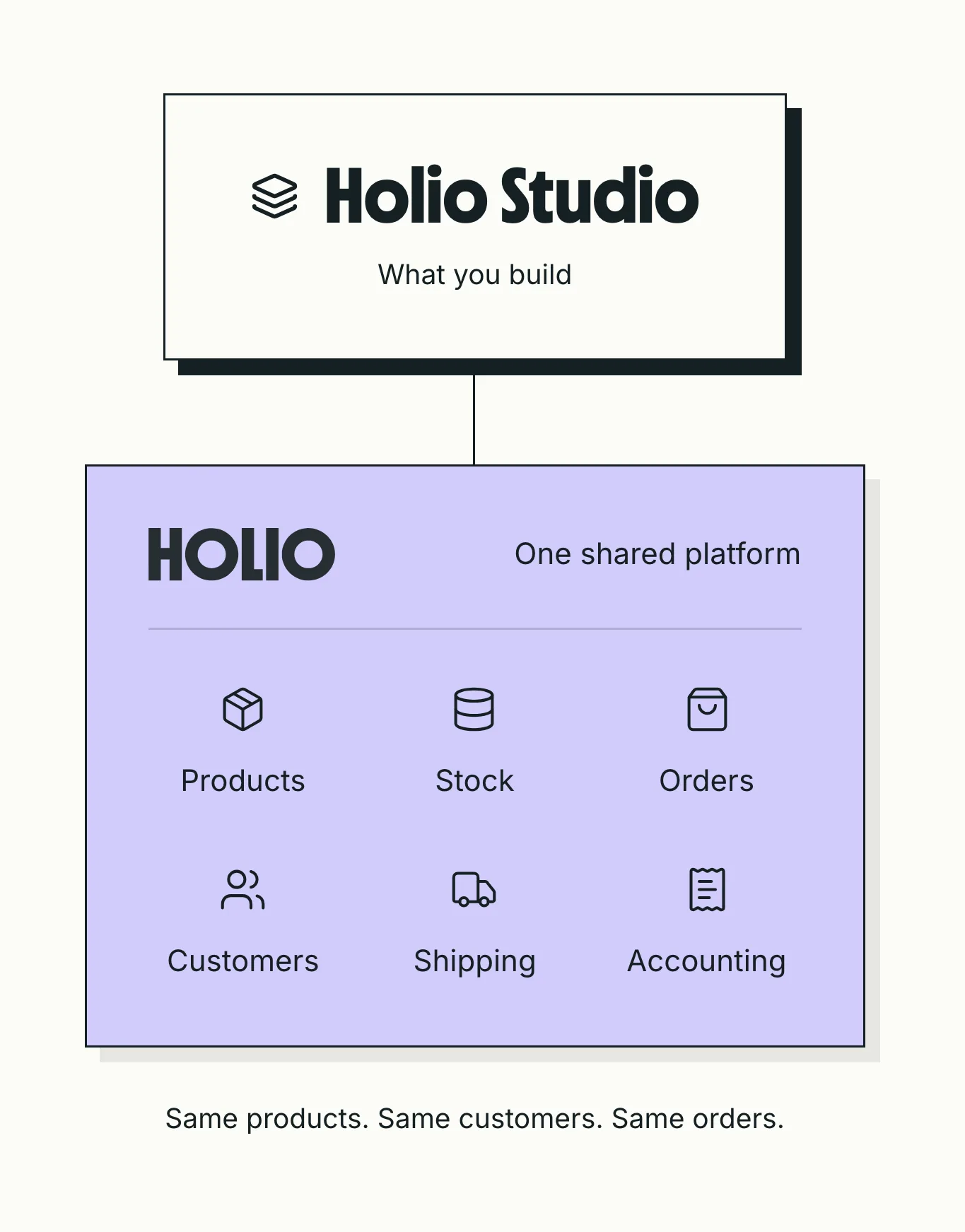
Connected on day one
No integration project. Each of these is the platform's own data, shown from the front.
Catalogue
Products, variants, prices and images from the platform's own catalogue. One product, every page.
Stock
What the page shows is what the warehouse holds. No nightly sync, no overselling.
Orders
A sale lands as an order the moment it is placed, and is handled where every other order is.
Shipping
Carrier rates through Profrakt, used by more than 1,500 Norwegian stores. Labels, tracking and pickup in the same flow.
Returns
Returns tracked as part of the order, not as a separate process bolted on afterwards.
Accounting
Visma Business NXT mirrored into the platform, so the order and the ledger agree.
CRM
HubSpot in the same ecosystem: the customer on the page is the customer in the CRM.
Search and Hilde
Semantic product search and Hilde, the assistant, on your own catalogue, in the EU.
Your own domain
Your domain with a managed certificate, once you have proved you control it. Until then the site has an address of its own.
Fast because there is nothing to boot
Pages are rendered on the server and cached per language. A complete marketing page on our own site is 63 KB of HTML and arrives in about 0.4 seconds, first byte to last, measured from Norway. There is no JavaScript application to download before anything shows.
Images go through the asset library and are served resized. Norwegian and English pages are cached separately, each expiring on its own, so a change in one language never flushes the other.
A CMS built for AI from the start
Pages are data: an ordered list of typed blocks with plain fields. That is what lets an assistant write one you can read, and what lets a validator refuse one that is wrong before it is stored.
Themes are tokens, never CSS, so a site stays consistent no matter who edits it. The assistant works on the same rows your editors do, with drafts, revisions, releases and translation you review — and a publish button that stays human.
What a page is made of
Twenty-three block types, each with a fixed set of fields. Enough to build a shop and a help centre, few enough that every page still looks like the same site.
Heroes and statements
The opening of a page, with up to four facts and two buttons, and a single highlighted sentence between sections.
Grids and splits
Feature grids with icons or images, and text-beside-media sections that alternate sides.
Steps and FAQ
Numbered processes and question lists. The FAQ block emits the structured data search engines read.
Products
Product lists filtered on brand or group, and a full catalogue picker, straight from the platform's catalogue.
Pricing and forms
Pricing tables with a highlighted plan, and forms delivered to HubSpot rather than to an inbox nobody reads.
Posts, media and documents
Blog post lists by tag, images, video and audio from the asset library, and downloadable document lists.
Questions about the shop
Can we keep our Shopify or MyStore shop?
Yes. Holio mirrors the catalogue and orders from Shopify, MyStore and WooCommerce into the platform today, so a Studio site can be your marketing site and campaign pages while checkout stays where it is. Moving the shop itself is a separate conversation, and we will tell you what it changes.
Who handles cart and checkout?
The Holio storefront, which owns cart, checkout and the customer's account. Studio composes the pages around it: catalogue, categories, campaigns, help and blog.
Do we get our own domain?
Yes. You prove you control the domain with one DNS record, the certificate is issued before any traffic moves, and the site answers on your name with no certificate work on your side.
What about search engines?
A new site is hidden from search engines until you launch it, so a draft never competes with your live site. Every page carries its own title, description and canonical URL, and the FAQ block emits structured data.
See your own catalogue on a page you described
Bring a product list and one campaign idea. We build the page on a walkthrough and you decide whether it goes live.